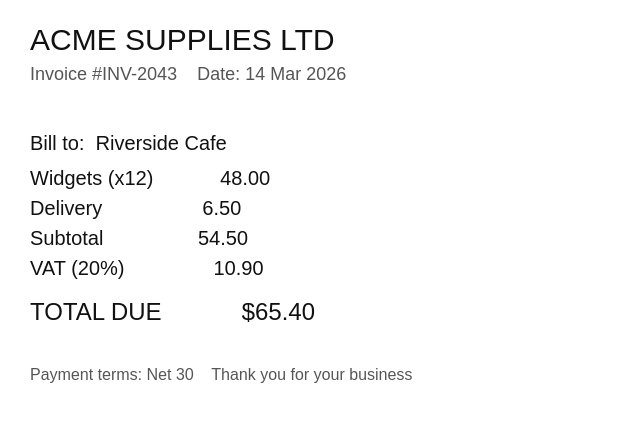
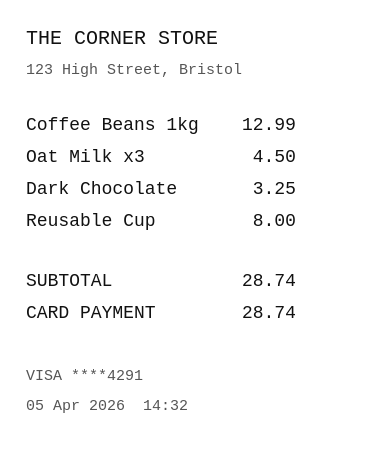
Donut reads documents the OCR-free way: there's no separate text-extraction step. A
vision transformer looks at the whole page and a decoder writes the answer to your question
directly — What is the total? → $65.40 — entirely on your device.
Swin Transformer image encoder → BART-style text decoder (VisionEncoderDecoder). No OCR engine.
Input
A document image + a natural-language question
Output
A short free-text answer, generated token by token
Quantization
q8 (8-bit) ONNX — separate encoder + decoder graphs
Backend
WebAssembly (runs anywhere; no WebGPU needed)
Download
~215 MB, cached after first load
License
MIT (naver-clova-ix/donut-base-finetuned-docvqa)
Web APIs
WebAssembly, Web Workers, FileReader — all Baseline widely available
Run it
Pick a document, type a question (or tap a preset), and hit Ask. The answer streams in as the decoder generates it — that's the real model, not an animation.
Drop a document here, or click to choose
backend –tokens –total –
See inside — the task prompt & the decode
Donut turns "answer this question" into text generation. Your question is
wrapped in a fixed task template and fed to the decoder as its starting prompt; the model then
generates the answer tokens that come after <s_answer>, each conditioned on the
image and everything decoded so far. Below is the exact prompt Donut receives and
the answer streaming out, token by token with timing. This is the real output, no
OCR step in sight.
Constructed task prompt
Ask a question to see the prompt Donut builds.
Answer tokens as they arrived
Ask a question to see the token-by-token trace.
first token –tokens –
Why it matters
Most document automation is a brittle chain: OCR the page, then hunt through the raw text with
regexes and rules. Donut skips the OCR step — you ask for what you want in plain language and it
answers, which makes it robust to layout and doing it locally makes it free, private, and
offline-capable.
Field extraction without templates — pull the total, the date, the invoice number by asking, not by writing a parser per document type.
Private paperwork — process receipts, invoices, and forms client-side; sensitive documents never touch a server.
Expense & bookkeeping capture — snap a receipt and ask "how much?" and "what date?" to auto-fill an entry.
Accessible documents — let someone query a scanned form by voice instead of reading dense layout.
The base call is a couple of lines with Transformers.js:
import { pipeline } from "@huggingface/transformers";

const docqa = await pipeline(
  "document-question-answering",
  "Xenova/donut-base-finetuned-docvqa",
); // downloads + caches ~215 MB once

const out = await docqa(documentImageURL, "What is the total due?", {
  max_new_tokens: 64,
});
// → [{ answer: "$65.40" }]
Under the hood Donut wraps your question in a task prompt —
<s_docvqa><s_question>…</s_question><s_answer> — and generates
the answer that follows. For "See inside", this page passes a TextStreamer into the
same call so the answer renders as it forms and each token's arrival time is recorded, all off the
main thread in a Web Worker.